
Artificial Intelligence and Creative Practice MSc (Online)

Blend AI with creativity
100% online
24 months (part time)
180 credits
4 starts per year
Request more information
Complete the form below for detailed programme and pricing information, and to be contacted by phone and email.
Explore how to use AI as a creative medium to shape what’s next
- Apply By: 05/02/27
- Start: 01/03/27
Rethink the boundaries of AI by exploring the intersection of technology and creativity with the online Artificial Intelligence and Creative Practice MSc/PGDip/PGCert. Delivered through the prestigious School of Computing, you’ll study the user experience of AI through creativity frameworks, combining theory and practice to use AI as a collaborator.
Designed for creative practitioners, this programme treats AI as a creative medium for experimentation and critique. Through studio-style, project-based design sprints, you’ll develop your practice and prepare for roles across film, TV, music, culture, design and animation.
Programme details
- Join one of the UK’s leading institutions for creative code
- Learn from decorated faculty with real-world AI expertise
- Explore a creative-first approach to ethical AI and responsible innovation
- Benefit from flexible entry and exit routes designed for lifelong progression
- Group-based learning that mirrors studio culture
- Curriculum built around project-based design sprints
- Gain exposure at an annual public symposium
Artificial Intelligence and Creative Practice MSc: Programme details
Click on each tab below to learn additional details regarding the programme requirements and features.
Curriculum
A curriculum that builds in-demand expertise
180 total credits
9 courses including the final project
Our curriculum combines theory and practice, balancing conceptual understanding with hands-on making. You will not just use AI as a tool, but also as a collaborator within your projects. The programme is structured around a group-based model and project-based design sprints, where you will rapidly prototype and refine creative AI concepts.
The Artificial Intelligence and Creative Practice MSc culminates in a major creative AI project. This is your opportunity to produce a substantial, original piece of work – such as a film, interactive installation or multimedia artwork – that elevates your practice and builds your professional portfolio.
What you’ll learn
Participate in group-based project sprints
An industry rarity, students work in creative cohorts from day one. This group-based structure helps you rapidly test concepts and build a portfolio of work in a collaborative, studio-like environment.
Benefit from proven excellence and creative legacy
Goldsmiths is an internationally recognised school for creative innovation and boundary-pushing arts education, with a strong record of producing ground-breaking work in AI and film and AI-driven music technology.
Build and showcase a major project
Bring your final AI project to a public symposium, attended by key industry partners. The event gives you the opportunity to present polished AI-driven films, prototypes, and artwork to gain feedback, recognition, and real-world exposure.
Entry criteria
Join a community of creative innovators
4 intakes per year
Flexible routes to entry
We welcome graduates from the arts, design, media, or humanities disciplines who want to add artificial intelligence skills to their creative practice. We do not assume that you’ve programmed before, and while we seek applicants with a bachelor’s degree, we do consider those with relevant work experience. For typical entry to this programme, you will have:
- A BA or BSc Degree at level 2:1 (or equivalent) or above in any subject.
If you do not meet standard entry criteria, we may accept applications with a lower degree and significant work experience. Alternatively, we may recommend joining the Artificial Intelligence and Creative Practice PGCert in the first instance. Contact us to learn more.
English language proficiency requirement
If English is not your first language, you will need to supply an up-to-date English language test certificate. We accept IELTS certificates with an overall score of 6.5, including a 6.5 in writing and no less than 6.0 in any band. Alternative test certificates are also accepted, and exemptions can be made. Please contact us to find out more.
Apply today
Review our admissions pages for more information on language criteria and how to apply.
AdmissionsFees & funding
Tuition to support your future in AI leadership
The estimated total cost of this programme is £12,500 GBP for the full MSc. You can pay in full or in instalments of £1,200 every module, and £2,900 for the Major Project (paid in two instalments over approximately 7 months). All costs are listed to help you make an informed decision.
Programme fees are reviewed annually and are subject to change each academic year. The fees listed above are for academic year 2026-27.
Fees and funding
We are excited to be offering discounts. Review our tuition and funding pages for more information.
Funding options
Advance your career in AI-led creativity
Graduates enter high-growth industries where creative AI is transforming animation, VFX, music, and advertising. This programme equips you with the hands-on skills and critical perspective needed to lead in this emerging field. You’ll be prepared for roles ranging from creative AI specialist to UX designer for AI products. With a strong portfolio of AI-driven projects, you’ll be positioned to secure roles at innovative companies and studios, from generative AI start-ups to established media giants.
Explore your potential career paths
Lead UX Designer £78,000 per year1
AI Creative Specialist £56,000 per year2
What you’ll learn
Upon completion, you will be able to blend advanced knowledge of AI with your creative practice. You will gain technical proficiency with AI models and generative systems, while developing the critical thinking needed for responsible and innovative use of AI.
Programme outcomes
- Integrate advanced AI knowledge with creative practice to design and evaluate innovative computational systems, artefacts, and experiences
- Critically assess emerging AI tools, algorithms, and methods in artistic, cultural, and professional contexts
- Implement and deploy AI models, generative systems, and digital workflows for creative and media industries
- Apply ethical, reflective, and inclusive judgement to the responsible use of AI, considering social, cultural, and environmental impact
- Communicate and lead across disciplines, collaborating on original, research-informed projects in creative technology
Meet your faculty
Our expert faculty members bring a wealth of knowledge and diverse perspectives to your learning experience. From AI and data science to creative coding, their shared commitment to innovation and excellence creates an empowering academic environment.

Dr. Rachel Falconer, Programme Convenor
Dr. Rachel Falconer
Dr Falconer is an established curator and authority in art practice and artificial intelligence, with a practice grounded in the critical and creative application of AI. She supports students in developing innovative creative coding practices and interdisciplinary AI projects that connect technological research with contemporary art discourse.
Together, these faculty members ensure that you not only gain technical expertise but also develop creative thinking and problem-solving skills to excel in a rapidly evolving tech landscape.
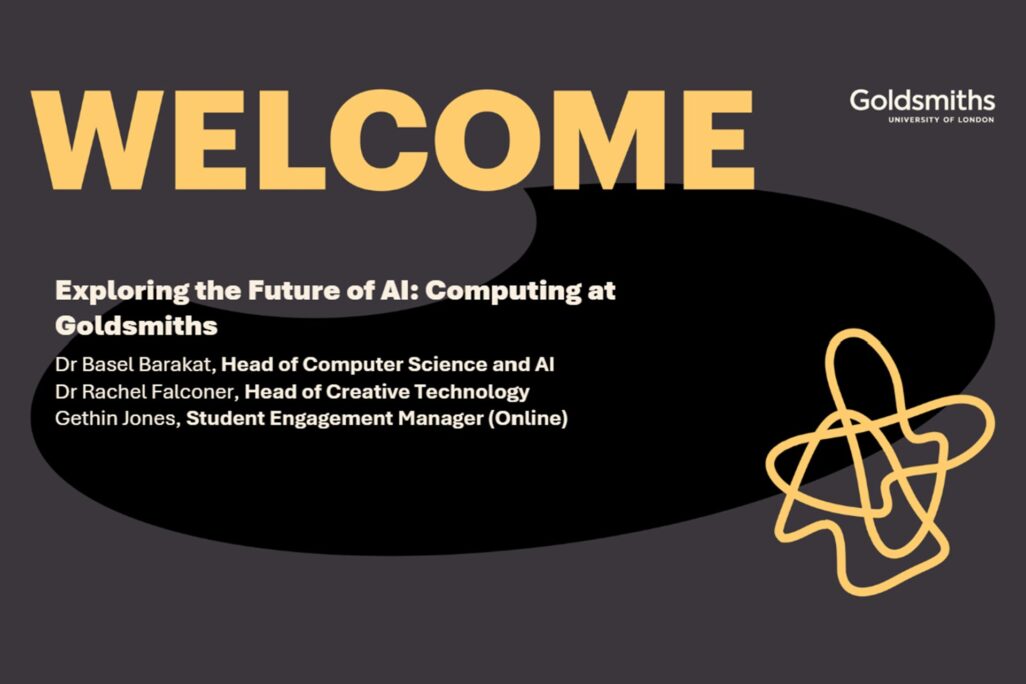
Gethin Jones: Hi everybody. Welcome to the session for exploring the future of AI: computing at Goldsmiths.
My name is Gethin Jones. I’m the student engagement manager at Goldsmith’s for the online programmes and this is the session for exploring the future of AI and computing at Goldsmith to look at the online programmes. We will be welcoming questions throughout the session. You can participate. You’ll see the Q&A function at the top of your screen. and you can post in there, and we’ll look through those hopefully throughout the session when it’s right in terms of conversational topics, but we might leave some to the end of the session as well.
If you see a question being answered that you might have already thought of or you like the response, please do upvote it because then it will help others in terms of the common trends and responses and we’ll try and answer as many questions as we can throughout the session. If there’s any that we don’t get to, we will follow up with you after the session, and you can get in touch with my team at the online admissions email address as well. So today we’re going to try and aim for around 45 minutes.
We will be meeting with faculty of the academic members of the team who were delivering these courses. We look at why choosing Goldsmiths. Some information around computing at Goldsmiths and the AI programmes as well. The details around the content and the curriculum careers opportunities and then the online study environment and the support and then how to apply with some questions and answers as well. So, without further ado, I’m going to pass you across to our special guests for some introductions. Basel.
Dr. Basel Barakat: Hello. Hi everyone. I’m Dr. Basel Barakat. I’m the head of Computer Science and AI subject area at Goldsmith. My work is mainly about AI and its applications, and how to apply it in real world problems. I had a lots of experience working in different projects with industry including hospitals with different companies that look at time series data and also, I have some experience working with companies that look at language models and LLMs and implementing them and I have been funded previously by the Royal Academy of Engineering and NHS Innovate and several other funding bodies. Thank you.
Gethin Jones: Thanks, Basel. Great to have you in the session today and across to Rachel.
Dr. Rachel Falconer: Thanks very much. Hi everybody. It’s great to be here and talk all things AI. My name is Dr. Rachel Falconer and I’m the head of Creative Technology at Goldsmiths and I guess I am a practitioner. I’m a curator, researcher, and educator that specializes in the critical study of computational and network culture within the area of contemporary art practice. And I’ve been involved in this in different institutions across different industries for many years. I have a specialism in the kinds of critical expanded approaches to AI and machine learning when it’s put in dialogue with creative practice as a collaborator.
I’m also the co-founder of co-founder even of the process iteration network which is a research unit dedicated to celebrating process over products and particularly within the area of AI and machine learning. It is an iterative studio of practice that is reflected through the research unit. It’s great to meet everybody.
Gethin Jones: Thanks, Rachel. Absolutely great to have you on board as well. I’m going to hand back to the academic team now to just go through a few slides around why Goldsmiths and some of the benefits of studying both the programmes within the faculty and being part of that community. I’m going to disappear for a little while and switch off my camera and my microphone. I’m going to hand across to Rachel and Basel.
Dr. Basel Barakat: Thank you. We at Goldsmiths, we have very much experienced staff in delivering online programmes. We’ve been leading and we are one of the first, if not the first worldwide university to run online programmes. We have world-class teaching staff who are experienced in running online programmes. We have at the school level about 70 plus members of staff who are academics coming with loads of experience from research and industry and they will be all working with you throughout these programmes.
Dr. Rachel Falconer: It’s a really great community of practice that we offer at Goldsmiths and being online and being part of this international community is something that we we’re very well positioned to deliver and also celebrate here at Goldsmiths. Oh, we have a question. Maybe not. Sorry, you’re muted.
Gethin Jones: I don’t think there’s a question quite yet. We do have people in the background looking at the questions. You carry on for a second.
Dr. Rachel Falconer: Perfect. Sorry, Basel, you go ahead.
Dr. Basel Barakat: We are delivering these online programmes and we are one of the top universities worldwide in online delivery but also we have been in London for more than 120 years as teaching in London with a lot of community connections, work with people around London, work with organizations and community and a lot of that experience will be actually coming to the examples, the projects that you’ll be working on in these programmes and you’ll find a lot of relevance to the industry in what we will be teaching. Rachel?
Dr. Rachel Falconer: Thank you. And Goldsmiths is really known for the kinds of critical application of creative thinking. Not thinking just about how you do something but why you’re doing it. What real life or real-world effects and challenges your creative thinking that you nurture and cultivate through the online courses at Goldsmiths? What do they teach you to apply to more critical methodologies that exist within real life situations and challenges as well? That’s something that is quite unique about the Goldsmiths offer and positioning.
Dr. Basel Barakat: Perfect. Can I go next slide please? Thank you. Why AI? Why to study a degree in AI? That’s a very hot topic nowadays, especially with the technologies that fully changed the industry. In my opinion, AI this is the right time for it. The technology has matured enough that it’s really disrupting a lot of industry. And a lot of the companies that never looked at AI now they’re adopting it. Some are already invested some are going through, so it’s very much the right time to get into this track especially for the people who’s looking into upgrading their skills to go maybe more senior positions getting promoted or if you’re in a different field and you are curious about AI and you want to do a career shift AI as a as a field of study or a research area is very attractive nowadays.
Dr. Rachel Falconer: For sure. And also, within the creative industries, it works on two levels. The first level is perhaps you’ve hit the skill set wall within your current company or firm and you want to upskill. This is a great way to do that because the demands and the fast-paced nature of the way in which AI and machine learning is changing within the creative industries, is something that is a challenge. That’s something that the courses that we provide definitely reflects. And then from the more creative industries’ perspective around what does the putting your creative practice in dialogue with the advanced technologies of AI and machine learning, what does that afford you as an arts practitioner?
How do you start to then integrate your machine learning and AI collaborator into interfacing with the art world as a whole which is also changing rapidly? And last but not least, what’s very important about all the online courses that we offer within the AI space is this idea of really challenging and responding and equipping you with the right terminology language and approaches to the very real ethical and social political implications of AI that is evolving as fast as the technology itself.
Dr. Basel Barakat: That’s one of our real highlights in Goldsmiths, isn’t it?
Dr. Rachel Falconer: Definitely.
Dr. Basel Barakat: We have a lot of experience in looking at critical thinking and how to look at advantages and disadvantages and sometimes even philosophical questions around a lot of these topics. That’s one of our highlights here. Just a quick fact running. This is for our AI programmes. We have two of them we’re presenting at the moment: AI and machine learning and AI creative practice. They’re both post-graduate level. anything like MSC, PGERT, PG Diploma as well included. This is the facts. I’m sure you can find them online as well. Generally it’s two year programmes as a part-time. You’ll be taking the modules in a slower pace than the full in campus programmes and you will be doing some taught modules and projects, eventually putting it all into a major project or a final project towards the end.
Gethin Jones: And we do have just to add as well this for for the summer for the summer intakes for June applications are open now and we do have a limited amount of summer scholarships to award as well. You can get in touch with my team once we share the details later but that’s an exciting opportunity for some applicants who are pretty much ready to to to enter the online space for studies.
Dr. Rachel Falconer: Perfect. Basel, would you like to introduce yours first?
Dr. Basel Barakat: Sure. Thank you. We wanted to also present for you here like what is the programme that’s right for me? So, if any of these tick this is exactly what you want then hopefully this will be helpful for you. The first one AI and machine learning. This is a very practical hands-on programming programme and they will be looking at using Python throughout all of the modules. You will get that hands-on experience with loads of examples working with very relevant data sets, some of them from industry, some of them academic. You will be building machine learning and deep learning and neural networks and also you will be doing we’ll get to the exact modules, but you will be doing a lot of the applications of these. You’re not just going to learn the theory and how does it work, you will be able to actually develop it put it in an industry level not just that top high view of these topics. You’ll get the experience, you’ll get the theory, and you’ll dig into other application side and the implementation side as well.
Dr. Rachel Falconer: That’s brilliant. And that’s something that goes across all of our pedagogy and teaching is the application of learning. Learning through doing, which is which is really, a great asset that Goldsmith’s brings to any learning environment. For the AI and creative practice, this is really aimed at creatives that really want to impact shape and have a critical embedded impact on the on the industry or across the creative industries as well. And it’s not really, it’s not looking at AI as simply a tool but it’s looking at it as an active collaborator. And this is quite a unique course in the sense that it is constructed solely on collaborative practice that is designed to reflect how the creative industries operate across the field. The sorts of skills that you’ll be gaining through the programme are sort of generative AI tool proficiency. We’re going to be having studios around AI enhanced prototyping. So prototyping is a crucial part of this programme.
We’ll be looking at data handling for creative AI as well. And as I said before the collaborative remote work scenarios that are embedded within each and every module is a really unique angle for the course. And it’s very much designed to reflect how industry works and as is the key skill of creative problem solving which is connected to, yes, the collaborative remote work that you’ll be engaging with but also through the portfolio projects that you’ll be doing with applied skills and learning through AI and machine learning tools.
And as we mentioned before, there is a huge emphasis at Goldsmith around ethical and critical awareness in general, but particularly within the AI and machine learning and advanced technologies arena, this becomes even more urgent to foreground. And by the end of the course, you will have participated in a public seminar. You will have exhibited a final piece of work and you will have a portfolio ready project to develop and scope and scale out into industry as a whole. So as Basel’s course is designed for the application of knowledge, so is the AI and creative practice and so it really is debating which one of these programmes is right for you on your journey through to AI machine learning pedagogy.
Dr. Basel Barakat: Perfect. Thank you. Let’s get into a little bit more detail. For the AI and machine learning as a postgraduate course, you’ll be doing all of these modules on the right. There will be research methods programming and algorithms, data programming and artificial intelligence. These beginning modules will be really helpful for you if you didn’t do programming before or you have, but it’s been a long time since you developed anything by hand. This will be your starting point. You’ll get a refresher. You’ll know how to use the new tools all the updates if you’ve been away from this industry in a while. You’ll get your hands on.
Then the second part we will be doing the AI, machine learning, and deep learning. This is the core, the fundamental parts of AI. How does AI work in the bigger terms? We’re not just speaking about generative AI here. We’re speaking about the whole area. Then these fundamental modules will be leading you to apply it. How does AI apply to language? This is very much how large language models work. ChatGPT, Gemini and these ones. Then we look also at computer vision. How does cameras, videos work with AI? How can AI locate things How can they make our life much easier and sometimes much better in terms of doing automated processes when dealing with cameras and pictures and eventually, you’ll take the machine learning operations which is very up to date.
This is one of the unique features about this programme that nobody else teaches, is that we will tell you that technologies the foundations the programming first, but also the industry cares quite a lot about how this going to be implemented how is this be as efficient as possible in the real world. If you worked in industry, how much time and computational complexity plays a big role when implementing things for users. Hopefully if you’re going to be building the new AI tools, how long would it run? How to make it as efficient as running and as possible? What resources from hardware to software to implement AI correctly? And after you learn all of this, you’ll put it in a major project in the final project where you can apply all these skills together to get you that final thesis or final dissertation for graduation.
Gethin Jones: There’s a quick question we’ve got regarding the project. If somebody’s working already working in the industry and they’ve got something with their employer or certain project, can they integrate that into the into the final project as well?
Dr. Basel Barakat: Of course. The projects are throughout the modules, not just the final one. A lot of them come from industry challenges and they will be working with the real scenarios, the real problems. Eventually the final year project. This is the highlight, the cherry on top of the whole programme and, of course, we would like to get students to work with industry, with real problems.
Gethin Jones: Excellent. Great stuff. Next one for the creative practice one for Rachel.
Dr. Rachel Falconer: Fabulous. Thank you. We’re just going through the different modules much as Basel did. The AI and creative practice is divided into three phases and it’s really designed to explore AI as a creative medium rather critically examining its possibilities, its limitations and obviously its cultural and social impact. And as I stated before, you’ll be working in a virtual studio, a shared virtual studio in a collaborative team right from the beginning that is really is designed to mirror real world creative practice as it evolves through the creative industries. You’ll be working in a peer-to-peer structure that reflects the way in which creative studios operate within the AI and machine learning field.
The first phase introduces you to creative AI and the key the first two modules are really about the introduction to creative AI and then this idea of collaborative prototyping in practice. If you’ve never worked in a collaborative group before then this module is really designed to give you the practical skill sets of navigating that situation. Then the two modules that follow in phase one, “more than human creativity” and “creative AI intermedial learning systems” are more about thinking through what the cultural context of creative AI starts to give you as a practitioner. This is setting the scene and then in phase two there are four different portfolio sections. The first one is “the AI and an-archive”. Looking at documentation processes, the way in which AI is positioned as a counter archival entity and looking at archives and archiving from a more practical point of view as well with AI and machine learning models.
The second portfolio session is the “professional practice for hybrid creators” which is really focused on positioning you as a as a creative technologist or an arts professional working in the field and looking at sustainable business models that might be useful for you to build into your practice as you exit the programme with these new acquired skill sets. And then portfolio three it’s called “critical convergence” which is I guess it’s a flagship module in the sense that it’s a public seminar. This is where you will be working towards publicly talking about prototyping and displaying the group projects that you’ve been working and we’ll have invited industry guests and curators and people from both the creative technology and the art world coming into to support the seminar itself.
And the last module in phase two is the “critical reflection” where you’ll be reflecting on the seminar the public seminar and conference in portfolio three and thinking through how to scaffold and build towards your final project which is called the major project in phase three which runs throughout the whole of that module and has 60 credits allotted to it. This is where you will have a sustained and continuous group project that will come culminate in a public exhibition.
Gethin Jones: Excellent. Sounds really exciting. Rachel, in terms of like industry partners and branches of the arts and stuff, is there any examples of where you’re looking to focus or who you’re working with already?
Dr. Rachel Falconer: That’s a great question. I mean we had a great collaboration last year with Tate and Anthropic. And we have a very good with Anthropic going forward, and Anthropic are very keen to be positioned within the creative sphere. That’s a really great example of an applied collaborative scenario that we worked with a major international arts institution and arguably one of the main players on the AI scene. That’s an example, but at Goldsmiths we’re really well positioned because all of our lecturers and academics are also practitioners. We come with our very lively network of international collaborators already embedded within our expertise as well.
Gethin Jones: Brilliant. Fantastic. Thank you, Rachel. Some information around market demand and opportunities in that context.
Dr. Basel Barakat: Of course, AI as a field is a big boom now. There’s a lot of interest coming into it. If we take just the UK as an example here, we have 11,000 plus active AI and editing and automation vacancies. That’s most up-to-date statistic but obviously these programmes will prepare you for the UK market and also international market.
The skills you’ll be getting apply for these vacancies and many others. 69% of them is on AI that’s just to show how much there are and also on the right here you have the salaries or the average salaries for different jobs that you can apply to and of course this will be giving you a lot of the practical the hands-on skills. But also we’ll be looking at not just the financial effect but also you’ll be getting a lot of the critical, the ethical thinking the way that might help you not just in these fields but also to make really effect in the future change have an impactful output hopefully once you know how things work and the ethical implications of them. This will be great for you it’s a win-win from both sides, from the market side from the impact sides from humanity side that’s at least the way I see it.
Dr. Rachel Falconer: Oh, I agree completely. And you’ve got to be in it and respond to the constant complexities of the of the field itself in order to be a player within it. This is why this would be a good opportunity to have a real deep dive and be in a very responsive environment as these changes are taking place in real time. It’s a constantly changing field of interrogation and having the ethical and critical faculties to be able to articulate those challenges as they as they as they present themselves is also a skill set in itself that that we’re really well positioned to support.
Gethin Jones: Thanks both. We got some information coming up around potential career opportunities. First of all, around the machine learning option, Basel. Yes of course. We have a lot of data to back this up. We have, although these are new programmes but the students who did our on-campus programmes this is where they’re actually working nowadays. We have people in NHS, we have in Microsoft, we have in many other examples. I can see your sample. They are very diverse interest. But these companies even if you look now at their available vacancies you’ll always find AI machine learning, deep learning implementation experts, MLOps cloud machine learning applications and all of that is in in high demand nowadays.
Gethin Jones: Thanks Basel. And then we’ve got a quick run through for the creative practice areas as well.
Dr. Rachel Falconer: No, that’s brilliant. It’s good to have that splash page of the most represented players within the creative technology industry. You can see that you’ve got everybody from runway through to Nexus Studios. We’re actively collaborating with deep mind within a research arena and we have a lot of different strands and tentacles into the creative industries. I can see here you’ve listed film and TV and animation which is represented through Nexus Studios games and interactive media which is obviously a huge industry to start to interface with advertising and branding.
We have great relationships with Beamer and other groups that represent digital studios that are very much engaged in the current debates and applications of creative AI. We’ve got data driven creative R&D, AI assisted music production and composition which is a very specific focus for the creative technology area at Goldsmiths. We have a lot of tech musicians that are working with industry within the AI field. Festivals and public exhibitions. That’s a huge area as well given the legacy of Goldsmiths as a whole and its reputation within the art world that’s very much reflected through the AI and creative practice programme and that’s a legacy that we continue to celebrate but also innovate as the art world changes and becomes more and more receptive to artists working in dialogue with AI as collaborative entities as well.
Dr. Basel Barakat: Also, one thing that’s quite important here for these programmes, your academic staff will be as Rachel said practitioners but also very much researchers. The programme will be helping you to get a job in the industry or if you’re interested in doing research and doing a PhD or doctorate degree, this will definitely open the door for you.
Dr. Rachel Falconer: That’s a brilliant point as well and that’s something that we’re building out as a School is, a very integrated pathway through to PhD education through thinking through where are the main research areas that our programmes offer that more deep dive, it’s a great point, Basel.
Gethin Jones: Excellent. Thanks both. really interesting and important points there. I’m going to talk for a little while now for a few minutes just on the on the online learning environment and how that’s going to work in practice. Just a reminder to everybody, feel free to post the questions in the Q&A.
We can pick some more up as we go along and then we can revisit at the end of the session as well. But, we want you to be empowered to develop skills, those power skills through the online learning experience, critical and analytical thinking. That leadership element and social influence, which is covered really well by Basel and Rachel earlier around industry links and how we look at the practical application of things throughout your studies.
The critical and social intelligence piece, Goldsmith’s reputation in terms of within that space in being progressive and thinking outside the box. and the pedagogy we talked about earlier as well, that’s a real important part and the way that we thought through these programmes and how we deliver them as well. In terms of the classroom itself, our Goldsmith online and adaptable learning team. They create these spaces for you to engage with. You’re going to be busy possibly balancing work commitments with family commitments, you’re doing an online programme to try and fit around your busy lifestyle and we have developed the interactive learning environments the assessments and the feedback process around that as well. Basel and Rachel, anything to add there in terms of like, managing time and how students will make the most of that in terms of independent studies?
Dr. Basel Barakat: Yes, of course. These programmes are made for people who might be doing their full-time jobs and just doing this on the side, there’s a lot of flexibility. There will be some recorded or there will be every week loads of material for you to go through and study. Some of the videos will be pre-recorded but also, we will have live online sessions for every module and that will be helping for the engagement with us.
And also, it’s quite an important point to raise up here that all of these programmes and the materials are built so they will be very much accessible. We’ll be doing all the checks for disability and accessibility. Anybody who is worried about that definitely don’t be. We have a team dedicated to work on this to get everything just perfect for the delivery online.
Dr. Rachel Falconer: No, that’s that I’d just like to echo that and the accessibility is one of the main drivers around Goldsmiths pedagogy and that’s something that we were very passionate about. I just wanted to pick up on some specifics around group work which is a major feature of the AI and creative practice and very much aware of the fact that we would hopefully have a lovely group of practitioners from all around the world and we will most definitely be accommodating different timelines, different time zones and forming a virtual studio in which students will be able to keep up to date with what is going on as far as their project development is concerned. And also have crits, peer-to-peer crits, that work across different capabilities and also timelines. So, these are things that we’ve very carefully designed into your learning journey as well.
Gethin Jones: Thanks, Rachel. We’ve got a question, interesting question, in the Q&A. We’ll pick up that now if that’s okay. This is from Louie. Thanks Louie. “My background is in commercial creativity rather than fine art practice. when the programme refers to creative practice, how broadly is that understood?” It’s quite lengthy question. “Is the course more focused on fine art and experimental computational art or would it also support applied commercial creative fields like advertising and brand etc.?”
Dr. Rachel Falconer: The answer to that question is that it’s a broad arena. When we say this is why the title was specifically chosen to capture the entirety of what we would call creative practice and also how the creative technology and the fine art world are actually colliding and becoming a much more complex scene. When we’re thinking through, I used to work in advertising and branding and communication, and also, I work across the art world. I have a strong portfolio career. They were slightly more divided say 20 years ago, but at the moment, certainly within the last five to seven years, the creative industries have become incredibly fluid. This is why we want to capture the entirety of creative practice.
Gethin Jones: Excellent. Thank you. Great question, Louie. A little bit more from me, and feel free to add to this as well Rachel and Basel, but the benefits of online learning. We talked already about accessibility, flexibility, organising in a kind of just-in-time approach, not frontloading everything all at once. We’ll pick it up as we’re going through the contact hours or the commitment hours roughly 15 to 20 hours per week. I don’t know if whether you want to elaborate on that Rachel and Basel, on the expectations piece?
Dr. Rachel Falconer: As far as the kinds of expectation around working when your agenda suits you is very much part a core part of the ethos of online learning. But also, particularly within I suppose my field of creative practice it needs to be something that you come to within the development cycle that you’re comfortable with as well. And this is a rough indication of the study time, but obviously independent learning and independent development of your ideas and creative approaches is something that you have to gauge for yourself as well. But we will guide you around that process if that’s something that you’re not 100% familiar with.
Gethin Jones: Anything to add there, Basel?
Dr. Basel Barakat: No, I would agree, I don’t think there’s much to add.
Gethin Jones: It’s something that we get asked from time to time as you can imagine, it’s a popular question in terms of commitment. How much time am I going to have to allocate alongside other life events if you like. That’s a rough guide as you said in terms of like what the as asynchronous content might be along with any live interactive sessions, group sessions as well. Obviously, that’s going to slightly differ a little bit by the by the module content and the approach of that content as well and but essentially it is a Master’s degree.
It’s a part-time Master’s degree or postgrad or postgrad diploma but again it will require good time management and good organisation as with any other degree course. Was there anything? Oh yes. Just a recap on that in terms of support as well. We’ve got the online library services, extensive collections around journals and research publications comprehensive in terms of your subject and degree focus. But then also outside of that, there’s going to be wider reading and learning that you can that you can tap into. Connections with your subject matter experts, your module leaders, the academic team as well. And there’s an excellent support service in terms of anybody that needs extra advice, support or any additional needs as well. Anything to add there both just in terms of support and delivery?
Dr. Basel Barakat: In terms of delivery, a quick point that’s quite important here. These programmes will run in a different way than the usual on campus delivery because for all the modules you’ll be running them one by one sequentially you’re not going to take multiple modules at a time. You’ll be very much focused on each, that will help for somebody who might be a little bit busy this week. They can catch up and it’s all in one module to at least you’re not going to get distracted. If you have loads of projects you’re working in your work and you want to focus your studies, it will be much easier to catch up because it’s a single module at a term at a week. All right? And then you’ll be able to focus on it, get it done, move on to the next one.
Gethin Jones: Thanks, Basel. Great points. Entry criteria. A little bit around the process and how to apply. For those of you who have already achieved a degree in a science, technology, engineering, mathematics or relevant equivalent if you like.
A 2:1 would be the expectation or we would – and this is for the machine learning course – we would accept a 2:2 degree with some additional work experience evidence as well, around about two years. And then for the AI and creative practice we would accept a 2:1 degree in any subject.
Obviously if you come from any of those areas that’s going to obviously benefit you on some level. Is there anything you wanted to add there Basel Ration in terms of entry and consideration of additional skills or non-standard applicants as well?
Dr. Basel Barakat: Yes, of course. for non-standard applicants, if you don’t fit within these doesn’t mean that, you cannot get in if you have a special case, you can always put it in the application itself and we do check that on a case-by-case basis. If there is anything that is not very clear we might ask you what do you have in this area or what did you do in this. It’s really done on a one-to-one basis if there is a special case.
Dr. Rachel Falconer: Yes, completely agree.
Gethin Jones: If English language if it’s not your first language, as well, just to outline what’s needed there we would accept IELTS of an overall 6.5 and no less than six in any of the categories within that or the equivalent. It’s not just the IELTS. We would accept all of the standard English language equivalent certificates. And if you’ve got any specific queries, don’t worry too much. You can get in touch with my team for any specific advice then. You can apply now. We do have applications open for June. Even though it’s just a few weeks away, we are in a position to consider applications immediately and we do have those scholarship opportunities as well that we referred to earlier. If you do get in touch then we can take you through that process too.
Essentially a degree certificate or a transcript of your results which includes and shows us the relevant grades, a CV or resume in terms of your recent work experience and your profile, and then evidence of English language if you need to. For those non-standard quote unquote that we talked about earlier. If you haven’t quite got the degree level that we’re looking for, we would ask for a personal statement then in addition just as part of the application. And if you scan that QR code there, you can go through to the application pages and make a start now or make an inquiry with my team, and then we can take you through the process. Should we go in and see if there’s some questions there? Was there anything that you wanted to add, Rachel, Basel, around the application process whilst I look at the questions?
Dr. Basel Barakat: No, it’s all good. Just the point about transcripts, you can apply to them if you’re expecting them to come from your university, and it takes time. We can accept them conditionally until you get the formal transcripts. There is a way if it’s not fully ready yet, don’t worry too much. There is some flexibility.
Gethin Jones: Brilliant. Thanks both. Right, we have a question here. What’s the difference between the MSc AI creative practice vs computational arts?
Dr. Rachel Falconer: The MFA. Yes. The MSc AI and creative practice is specifically geared towards a greater focus on AI and machine learning. We do cover that area of study and application of creative approaches to that area in the MFA offline. But the computational arts MFA is also not designed to be a collaborative group work scenario whereas the AI and creative practice online is.
The MFA computational arts is really a broader spread of different technologies and approaches to creative practice. whereas the MSc is an MSc rather than an MFA and is most definitely geared towards skilling around AI and creative practice. They’re quite different both in the skill sets that you’ll be coming away from the programme with and also the look, feel, and experience of the actual programme itself.
The MFA is very much concentrated around your own practice as an individual whereas the MSc is more about more industry responsive group or collaborative practices. There are differences, there are similarities and if you want to have a deeper discussion about which programme might work best for you then please do reach out and I’d be happy to walk you through the different scenarios as well.
Gethin Jones: Thanks Rachel that’s really helpful. Get in touch with us and then we can follow up with any specific questions. Thanks for that question. Oh really really great. And then Anushka has sent in another question.
Studying alongside a full-time job, question about how the pacing might work in practice. If they have certain weeks where they can dedicate more time, would it be possible to progress faster during those periods? And if I happen to complete a module before the standard period, would I be able to start the next module early? Is there any flexibility in terms of how that progression works, Basel and Rachel, or are they stuck to a specific eight-week period, for example?
Dr. Basel Barakat: The way they’re made at the moment that, you cannot progress to the next module until you finish but you can progress within the module itself and you can start working on the project earlier or in your coursework if the module has a coursework there is some flexibility to progress within the module itself. And this happened actually for a quite good reason. In that there will be some holiday time. around usual holiday time around in the UK around Christmas and Easter there will be some time off and hopefully if you want to take some time off you can do that and it wouldn’t be pushing you above. Also, if you have any local or religious holidays you can fit within that as well.
Gethin Jones: Thanks, Basel. And a quick question around obviously Goldsmiths location in London. For anyone close to London or living in in the area, are they able to engage with the community even though they’re part of the online degree programme for example? Is there any opportunities in that in that sense?
Dr. Basel Barakat: Once you’re registered as our student you will have full access just like any other student. You’ll have access to the resources the online stuff plus the library if you need to access it and you can attend all the events and on that happens in campus.
Dr. Rachel Falconer: And be part of that vibrant community of students and the library is a great place to build that community. But as are the open lectures and as a creative you are most definitely welcome to all of the exhibitions that we that we have on campus as well.
Gethin Jones: Brilliant. Thanks both. A quick follow-up from Anushka. I’m also currently finishing the bachelor’s degree in creative computing and wanted to ask her whether the AI and creative practice degree is a strong progression and pathway from that background?
Dr. Rachel Falconer: Most definitely. That would be a great combination. That sounds like a very strong pathway through. I, as subject area lead in creative technology, I’m very familiar with the creative computing degree and it would be a very good combination and pathway through to specialization.
Dr. Basel Barakat: And also, this goes to across both programmes actually that we, the same staff, who teach in our campus will be teaching online as well. If you’re already one of our students, you’ll feel very familiar.
Dr. Rachel Falconer: Exactly.
Gethin Jones: Brilliant. Thanks and thanks for your questions. really fantastic. we’re probably going to wrap up here. we’ve run a little bit over the intended 45 minutes, but I thought it was a really great informative session. Thank you so much to Dr. Basel Barakat, Dr. Rachel Falconer. Some really brilliant insights and I’ve learned a lot as I always do, and I love these sessions. Please keep in touch. The QR is there if you wanted to come through to look at the applications and the programme pages, look at the curriculum in more detail. but reach out at any time to my team and then we can put you in touch with the faculty team as needed then as well. Thanks again everybody and hopefully we’ll catch up with you soon. We’ll follow up with everybody after the event with some more information as well. But have a great day and hopefully we’ll catch up soon. Thanks, Rachel and Basel.
Dr. Rachel Falconer: Thank you. Thanks everybody.
Dr. Basel Barakat: See you soon. Thanks everybody. Bye, bye.
Related programmes
Sources
- 180Glassdoor, “Lead UX Designer.” Retrieved on Dec 9, 2025, from https://www.glassdoor.co.uk/Salaries/lead-ux-designer-salary-SRCH_KO0,16.htm.
- Glassdoor, “AI Creative Specialist.” Retrieved on Dec 9, 2025, from https://www.glassdoor.co.uk/Salaries/ai-creative-specialist-salary-SRCH_KO0,22.htm.