
Foundation in Computer Science (Online)

Think like a computer scientist
100% online
15 months (part-time)
120 credits
4 starts per year
Request more information
Complete the form below for detailed programme and pricing information, and to be contacted by phone and email.
Future-proof your career in tech with Foundation in Computer Science
- Apply By: 02/10/26
- Start: 26/10/26
Gain essential skills in mathematics, programming, and computational theory with the online Foundation in Computer Science programme, delivered by the School of Computing.
Designed to prepare you for degree-level study, the programme introduces core computing concepts through modules in programming, computation, and mathematics for computing. This 15-month, part-time course supports learners from diverse backgrounds and prepares you for BSc Computer Science study at Goldsmiths and beyond.
Programme details
- Join one of the UK’s leading institutions for creative code
- No prior technical background required
- Clear progression to BSc Computer Science pathways
- Digital-first delivery for international access
More information about this programme
Click on each tab below to learn additional details regarding the programme requirements and features.
Curriculum
Master the essentials of computing
120 credits
8 modules
The curriculum balances conceptual understanding with practical application. You will cover essential mathematical concepts, learn the principles of programming (using languages like Python), and understand how computing machinery operates. By focusing on underlying concepts rather than just current tools, the Foundation in Computer Science future-proofs your learning, enabling you to adapt to new technologies throughout your career.
What you’ll learn
Core programming concepts
Go beyond syntax to understand how coding works and learn to write programs to achieve basic functions and deconstruct complex problems into manageable units.
Computational theory and systems
Gain a deep understanding of basic computation concepts and computer systems. This module provides the theoretical grounding needed to understand the basis of computation, its connection with algorithms, and how hardware and software interact.
Numeracy foundations for computing
Develop the essential numeracy and logic skills required for computer science. You’ll apply mathematical techniques to solve computational problems and compare problem-solving algorithms.
Entry criteria
Your pathway to a career in computing starts here
4 intakes per year
The Foundation in Computer Science is designed for students without a formal academic profile to enter degree-level study directly. You do not need a background in computing. For typical entry to this programme we require you to:
- Demonstrable numeracy skills at, or equivalent to GCSE Mathematics grade 4 (C).
- Be at least 17 years of age or above at the start date of your first module.
Whether you are a career changer or returning to education, this foundation provides the bridge you need.
English language proficiency requirement
If English is not your first language, you will need to supply an up-to-date English language test certificate. We accept IELTS certificates with an overall score of 6.0 and no less than 5.5 in any band. Alternative test certificates are also accepted, and exemptions can be made. Please contact us to find out more.
Apply today
Review our admissions pages for more information on language criteria and how to apply.
AdmissionsFees & funding
Tuition
The Foundation in Computer Science offers an accessible entry point into the tech industry with a transparent tuition structure.
The estimated total cost of this programme is £9,535 GBP for the full programme. You can pay in full or in seven instalments of £1,192 every module, and a final payment of £1,191. All costs are listed to help you make an informed decision.
Programme fees are reviewed annually and are subject to change each academic year. The fees listed above are for academic year 2026-27.
Fees and funding
We are excited to be offering discounts. Review our tuition and funding pages for more information.
Funding options
Unlock diverse career opportunities in technology
A Foundation in Computer Science opens doors to a wide range of progression opportunities. Successful completion qualifies you for undergraduate study in Computer Science, where there is the opportunity to choose courses with specific specialisations depending on your interests. The skills you gain in programming and computational thinking are highly transferable – supporting careers in high-growth sectors where technology roles are projected to grow faster than average over the next decade.
Explore potential career paths
Web Developer £41,000 per year1
Systems Analyst £44,000 per year2
What you’ll learn
Your time on this course will be spent learning to bridge the gap between your current knowledge and degree-level computing. You’ll gain the confidence to apply abstract reasoning to concrete problems and the technical ability to write and understand code.
Programme outcomes
- Apply mathematical techniques to solve computational problems.
- Write programs to achieve basic functions and solve problems.
- Understand the basic concepts of computation and how computing machinery works.
- Solve complex problems through deconstruction into smaller units.
- Discuss the impact of technology use and development.
Meet your faculty
Our expert faculty members bring a wealth of knowledge and diverse perspectives to your learning experience. From AI and data science to creative coding, their shared commitment to innovation and excellence creates an empowering academic environment.
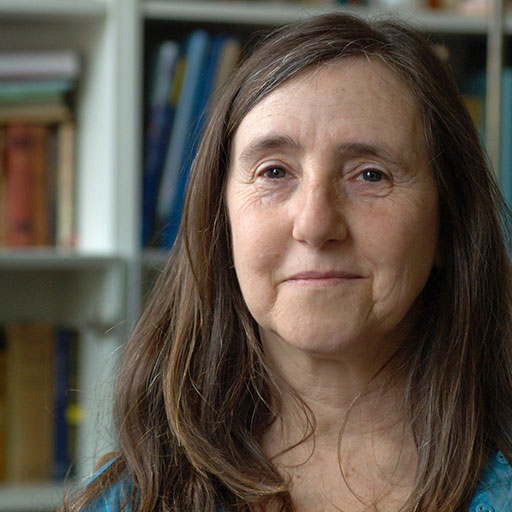
Dr Sarah Rauchas, Programme Convenor
Dr Sarah Rauchas
Dr Rauchas is a Computer Scientist with a PhD in Artificial Intelligence and an MSc in Computer Engineering. She’s taught topics such as fundamental computer science, creative computing, data science, and thesis work. Dr Rauchas’ research includes robotics, computational linguistics, computer science education, and most recently, she has been engaging in data science as the programme convenor for the online MSc in Data Science.
Gethin Jones
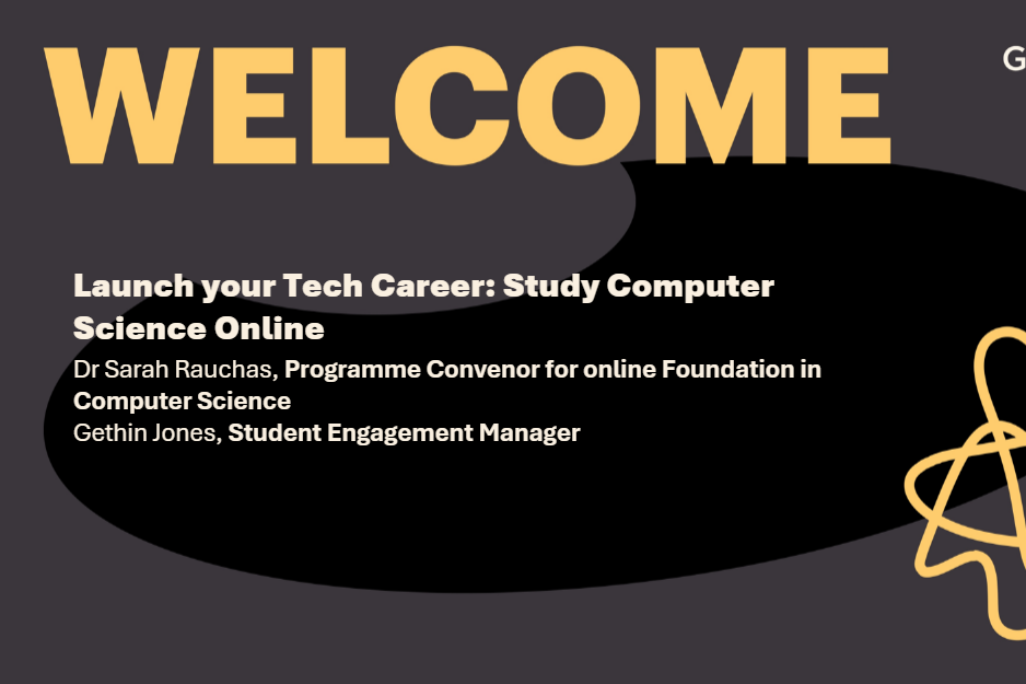
Okay, welcome everybody to our webinar for Goldsmiths, University of London.
This is the “Launch Your Tech Career” session looking at studying computer science online at Goldsmiths and particularly the online foundation course.
So I’m Gethin Jones, I’m the student engagement manager for the online courses at Goldsmiths, and I’m also joined by the programme convenor, Dr Sarah Rauschas, as well. We’ll do some introductions in just a second. But first of all, we’ll do some housekeeping. So
We’ll do some introductions in just a second. But first of all, we’ll do some housekeeping for the session.
You will be able to ask questions. You will see a little Q&A function at the top of your screen. I can ask questions in there. And if you see questions coming up and you think, that’s something that I need an answer to, or if you like the response you can always upload it and then it will be there for other attendees to see first. And we’ll try and answer all the questions during the session.
So we might do that throughout the content as we go, or we might leave them until the end, depending on the nature of the questions. And if there’s anything we don’t get to, we’ll follow up with everybody after the session on email as well. So, we will make sure that nothing is missed.
And some of the stuff we’re going to cover, so we’re going to have a bit of an introduction to the faculty and teaching team, why Goldsmiths and why computing at Goldsmiths in terms of the subject area. We’ll look into the programme, some of the content for the modules, career opportunities in future, and then we’ll have a look at the online study and learning environments and the applications process as well. Plus, as I just mentioned, you’ll have a chance to ask questions and engage with Dr Rauchas and myself as well.
OK, so for the next slide, I’m going to hand you over to Dr Sarah for an introduction. Thanks.
Sarah Rauchas
Thanks very much, Gethin. And so hi to all our attendees and anyone who will be watching this later. Yeah, I am the programme convener for the Foundation in Computer Science and I absolutely love this subject. I love the foundations of computing, the underlying theoretical things that make us able to do the things that we now can do with computing and computer science.
So foundation is really one of my passions and I’ve been very excited to be involved in developing this programme and in developing some of the modules that are part of it. My background is that I did a fairly conventional computer science undergrad degree.
I did a master’s in computer engineering, mainly because I wanted to learn how to solder the little bits of printed circuit boards. Not the only reason, but I was quite frustrated at my degree being very kind of
I suppose ‘hands-off’ is maybe a way to describe it.
So I wanted to get my hands dirty and work at the circuit board level. So I did that MSc and then I became very interested in artificial intelligence. So I went off and did a PhD in AI.
My PhD was in computational linguistics, so natural language processing, at a time way before large language models. This was a time when everything was about how humans do language and about grammar and about how you get understanding from that.
The field has moved a long, long way since then, but the whole big joined up picture of where it started and where it is now is a really, really interesting one. And it’s kind of part of what we’ve brought into the foundation. I’ve also done research in robotics, computer science education, creative computing, and that’s one of the really strong points of strong capabilities and features at Goldsmiths, which I’ll mention a bit later.
And I’m also really, I really love supporting student projects because I think when people get the chance to do what they really want to do, that’s when they shine. So that’s me. And I think the main message is I really love this stuff.
Gethin Jones
And it comes across. Thank you so much, Sarah. That’s a lovely introduction and a good summary and a good kind of way in for us to chat a little bit about studying at Goldsmiths. You mentioned there that like the reputation and the identity and the community elements as well and the creative aspirations of Goldsmiths.
The online degrees then relatively recent introduction to Goldsmiths then. So what are your insights or thoughts on how that’s adding to the community of Goldsmiths and what opportunities it might bring for students then?
Sarah Rauchas
So one of the main motivations for doing this online foundation degree is that we’ve had many, many applicants to the on-campus foundation degree. Foundation degrees are fantastic as a bridge between either school education or people who have been out of education for a while, to get back into a subject area or a career track that they are interested in.
So the Online Foundation does two things.
It gives more capacity for students wanting to do a foundation programme. And it also allows students who aren’t based in London or can’t access goldsmiths physically in an easy way themselves to do a solid computer science foundation programme.
And there are Goldsmiths on-campus foundation and also the Goldsmiths on-campus degrees are very closely linked to this because we’ve made the foundation, the online foundation programme very, well, if a student succeeds in this, then access to the undergrad degree is really, really quite straightforward and very achievable.
Gethin Jones
Brilliant, thanks Sarah. And I think that’s it, the flexible entry and also the part-time element and the online element will open the door to lots of other students and the opportunities. So University of Goldsmiths, University of London, you know, well known for its, you know, identity and kind of community mission and
Sarah Rauchas
Exactly.
Gethin Jones
you know, that progressive thinking and critical thinking elements as well. Is there anything from your experience, Sarah, you wanted to share in terms of, you know, the courses linked to that, to that brand and identity for Goldsmiths?
Sarah Rauchas
Well, I think the one thing I want to say is that most people see Goldsmiths as it’s the creative university where all these art and creative and education and innovation sit. But it’s also really true that Goldsmiths has a very strong computer science department that has been strong in solid computing for decades.
So it’s really, what came out of that combination was that Goldsmiths were the first UK university to offer a degree in creative computing a number of years ago. That then became very popular in other universities and for many students. But there’s still the flavour of the creative, but it is connected with really solid theoretical foundations in computer science.
So what I love about Goldsmiths is that you’ve got both and the solidness as well as the innovation and creativity make it a really inspiring place to work at and to study at.
Gethin Jones
Thanks, Sarah. And yeah, we’ve got some insights into kind of rankings and reputation and, you know, some of the historical elements there for Goldsmiths too. So computer science, you mentioned a little bit about your experience about the on-campus version versus the online and the sort of history and approach and stuff. So in terms of careers or earning potential, you know, future direction, why would you say studying computer science is important then, Sarah?
Sarah Rauchas
Well, I think the way that we’ve tried to position the foundation is that it is a way to study computer science as a kind of degree, but it is also a way for people who aren’t yet that comfortable with the concepts of computation to get to learn a little bit about these things that are here and they’re here to stay.
So it really is two things. And you don’t have to. Becoming a computer scientist is not the only reason to do a foundation programme in computer science.
A foundation programme in computer science gives you an understanding of how these machines work. How they fit into society, how they fit into the workplace, and how they fit into where our future is going. And if that is an interesting thing for you, then yes, you may wish to become somebody who works in the area of computer science and computation, there are lots and lots of jobs, roles and future potential.
And I know that at the moment a lot of people are saying, but isn’t AI going to take all of that away from us? And we’re not going to have these kinds of jobs. I think it’s the case that first of all, people, human beings have to make the AI stuff to start with.
And secondly, there is really a big role for people to use and deploy and curate what we will get in an AI-enabled world. And to do that, understanding what this stuff is about and understanding what computer science is about positions you in a really, really strong place to have a positive and strong career.
And what we really talk about, possibly not from the foundation, but the foundation is a start, but from the position of having done a decent computer science degree, that puts you in the position of not being
the users of the next technology, but the designers and makers of the next technology.
So this is really about the future, as well as enabling for the now.
Gethin Jones
Brilliantly put. Thank you so much, Sarah. In terms of some quick facts around the programme itself, so some of the practical considerations.
So flexible course over 15 months part time, so 120 total credits, which we’ll come on to in a bit in a second in terms of what that means.
Eight modules in total. And then we’ve got a quick run through of the tuition fee structure. But I would say it’s a kind of 1 module at a time approach, part time, flexible in terms of, you know, you’re not going to take everything on at once in terms of lots of different modules. You would progress one at a time.
And then if you were to want to spread out in terms of the cost of the financing as well, that works in the same way. So there’s a kind of pay as you go every module approach there too. And just to add as well, which you can touch on a bit later, is that for the August intake, so it’s August 31st start, we do have an excellent opportunity over 1000 pounds scholarship for anybody that starts in the August as well.
So good opportunity where I think the application deadline is still a few weeks away, I think of the 7th of August for the 31st of August start. So that’s still available too. If we go on to the next one, I think we’ll talk more about those curriculum details then, Sarah.
Sarah Rauchas
Yeah. That’s great, thank you. So yes, the way that the foundation programme is structured it’s kind of in two chunks. And you can take the courses in the first chunk in any order you like.
and you can take the courses in the second chunk in any order you like. And they’re labelled here as Block 1 and Block 2.
So, but block 2 really builds a little bit on what you learn in block one. So we expect that you will at least complete the relevant block 1 module before continuing with the block 2 module. So as an example,
You could do any order of the introduction to mathematics, foundations of programming, fundamentals of computation, and the fundamental skills. You can do those in any order, but if you wanted to then, sorry, you don’t have to finish all four before you move on to block two.
2 modules. But to continue with the foundation, with the, for example, problem solving and programming module from block 2, you would have had to complete fundamentals of computation. So there’s really a great deal of flexibility, but it’s also combined with a kind of building rather than everything being at the same kind of level.
And the programme, I think, is quite a special programme in that it doesn’t, I don’t know, Mickey Mouse, for want of a better word. It doesn’t Mickey Mouse the conceptual aspects, the reasoning, the critical thinking, all of that. We don’t dumb these down, but that shouldn’t be seen as a scary thing. It should be seen as an exciting thing because we think they’re important, and because we think they’re important, we give a lot of effort into making sure that they are explained in good ways, that they’re explained in many different ways, so that students on our programme do get to really understand all of the core concepts in a very confident way.
We really have also incorporated a critical thinking and self-reflection aspect so that by the end of the foundation we expect that the people who have completed it will be able to look at something that they have done and decide for themselves whether they know what they’re doing.
And I always feel that knowing what you don’t know is as important as knowing what you know. And not knowing stuff is not a crime. It’s not an awful thing. It is an opportunity to learn. So that is kind of how we’ve designed this foundation.
The 4 topics that we have in each block are, broadly speaking, kind of mathematically based, coding based, computational theory based, and fundamental skills both for study and for computing. And that really covers a very good and solid way of doing things. Learning programming without understanding what computation is, is much harder than learning programming as well as understanding what computation is.
And likewise, to understand some aspects of programming or coding, knowing the maths that has underlined, or yes, was used to develop those particular approaches to programming is good.
So we’re not turning students into mathematicians, in a way, but we are enabling them to use the appropriate mathematical reasoning and thinking in order to become good coders. We’re not just turning out good coders. We’re turning out people who understand about how computation systems work.
Gethin Jones
Brilliant. Thank you so much, Sarah. So a little bit of information around careers and further study pathways. You mentioned earlier around progression, routes after completion of foundation. Do you want to give a little bit of insights into, you know, what some of our students might go on to?
Sarah Rauchas
Yeah, so I think a large majority of the students on the foundation are interested in access to a BSc in computer science or computer engineering or data science or one of the other computing related BSc degrees.
We do, as I said, we do feel that there is an application for mid-career people who are working in a field that is computation aligned, perhaps, and really want to understand more about the computation and computer science aspects.
So there may be people who just want to do the foundation so that it allows them to progress in their career and as a promotion route.
So yeah, it’s the fact that what we include is the coding as well as problem solving as well as critical analysis of technological scenarios and technological solutions is really something that does help people.
So the career and further study pathways are really to a computing related BSc degree or to a different place in a career that is already in progress.
Gethin Jones
Yeah, it makes perfect sense. Thanks, Sarah. And the computer degrees at Goldsmiths, then if someone was wanting to progress on to another course on campus, that’s an option. But then they can they can use that for, you know, a course elsewhere as well. So it doesn’t actually tie them into anything either.
Sarah Rauchas
Exactly. So that is a great thing because the foundation gets people into a BSc degree across the world, any appropriate BSc degree. And as the slide shows, there are all kinds of exciting careers that a computing related undergrad degree could take you into across the board.
We particularly mentioned some of the more creative ones here because the Goldsmiths undergrad degree includes that. But the foundation gets students access to other kinds of computing and computer science degrees, more kind of database-y or data science-y or medical computing, there really is a massive range of opportunity within the computing and computational tech world. And this foundation is a really solid one to allow you into those opportunities.
Gethin Jones
Brilliant. Thank you, Sarah. So, a little bit about the skills that developed for the online studies at Goldsmiths and this as well. So, so we put quite a bit of work into, you know, how we approach that.
So, for either working professionals that are looking to maybe, like, as Sarah alluded to, maybe change careers or develop their skills in computing, or for younger learners that are looking more for access to higher education as an option for that route.
You know, we need to make sure that you are developing those skills for resilience, both for, you know, the critical and analytical side of things and the tactical, but also the organisational skills and the prioritisation and the balance in your workloads and priorities and stuff as well.
And it’s very much human centred around that teaching approach and how we create the kind of community and feedback loops with the academic faculty teams as well.
Is there anything you wanted to add there, Sarah, in terms of, you know, how that, from your perspective, from the teaching staff?
Sarah Rauchas
I want to add that students who study part-time and online, in my experience, and I have quite a, like a couple of decades experience of this, they have special skills because they manage to, they learn how to manage their own time really well.
That’s the resilience, the flexibility, the agility. And online has its challenges, but it also has its real benefits. It gives you the flexibility and it gives you a way of learning how to do this kind of thing in a, in a, almost in a, I don’t want to say, you know, you’re thrown in at the deep end because you’re not, but you do end up learning how to manage an online environment in a much, in a really strong way.
And if that is, again, if that’s the future of your work, then this is a really, really important skill. Yeah, and we also do, as I say, we have students do develop the ability to manage priorities.
And having said that, you definitely are not online only and there are never, there’s never contact with humans. The contact with humans is online, but it’s not just you looking at slides or pre-recorded videos. The actual interaction is a really important part, as well as asynchronous interaction with faculty and with fellow students. So all of that is a really important part of the kinds of skills that you do develop.
Gethin Jones
And then as part of, you know, that classroom elements, I think, you know, each, is it fair to say like each module will have a slightly different approach to like assessments and possibly peer review and group work and assessments and stuff like that?
Sarah Rauchas
Yes, yes, they all are slightly different and they are kind of designed to be appropriate to the content of that particular module. Yeah.
Gethin Jones
Yeah, and the GOAL team at Goldsmiths, and I’m just like a bit distracted by this like animated slides here. So that just keeps flashing. That’s a really good example, actually. Yeah, so the online programmes using, you know, the virtual learning environment and, you know, the digital tools available within that environment to make it as interactive and as enjoyable as possible.
But there will be, as you know, Sarah mentioned, the personalised feedback and you will get to engage with others, you know, albeit in an online environment. And there will be an element of contact time or to request contact time where possible then, Sarah.
Sarah Rauchas
Absolutely, absolutely. And myself and the other kind of module leaders will have time available to have group and individual interaction with students from time to time as appropriate. But there also are scheduled in-person webinar session, not in-person, online webinar sessions.
They are scheduled, there’s not one every week, but there’s always an asynchronous interaction every week and engagement with your peers, as well as with the faculty who are the specialists in the different module areas.
Gethin Jones
Yeah. And then some of the benefits for online, we touched on some of this already, but you know, obviously the accessibility and the flexibility to manage, you know, some of that study time within your busy, your busy kind of work balance or family commitments.
The recommended study time is roughly around 15 to 20 hours per week study.
And as we mentioned before, you know, it will be 1 module at a time where you’ll have weekly activities and there’ll be different elements of interactions and assessments within that then. Any other benefits you want to touch on from your perspective, Sarah?
Sarah Rauchas
Yeah. I think that’s, that we’ve kind of, we have covered that. Thanks very much, Gethin. I think that’s a good summary.
Gethin Jones
Perfect. And then in terms of support, so there is comprehensive online library resources that all students will have access to. So if you do apply and you get yourself an offer in place, then as you approach the enrolment, the period beforehand, you will be sent information for you to register and access all the reading lists and library services as well.
As we mentioned just now, you’ll be able to connect with the team at certain frequencies and certain times of the week or times of the month. And then we will have comprehensive additional support, wellbeing, study skills, disability support if you need any additional time or support with assessments and study skills as well.
So quite holistic, you know, it’s an online course that’s, you know, is relying on that online content and your kind of self-study approach, but there is a lot of content and resources and support available too.
Sarah Rauchas
Yeah, I think that, that again, that really summarises it very well. Thank you.
Gethin Jones
And in terms of entry criteria, so this is sort of my team would be managing both engaging with yourselves as potential applicants, but then also guiding you through the application process.
When we talk about entry requirements, you know, fill in the application form, getting the responses from the admissions team and then, you know, providing you with all the updates as you go up to enrollment as well. So that would be quite a lot of engagement from our lovely advisors.
This is very, you know, because it’s a foundation programme, the requirements are very accessible. So we would only require a GCSE mathematics around grade 4C equivalent.
And then at least 17 years of age or above, you know, to start your first module. So this could well be a mix of, you know, early sort of school leavers looking for access to higher education and a full degree later on, but also, as you mentioned earlier, maybe more mature learners who are looking for the career changers to develop their skills personally as well.
So regardless of which, you know, end of that sort of spectrum you are, it doesn’t really matter in terms of entry. We would apply the same kind of entry criteria and it is an accessible programme. And we would consider also if you’re not quite at the level in terms of maths and stuff and you’ve got other work experience, then we would still consider an application as well.
Sarah Rauchas
Yes, absolutely. Send those in and we absolutely, we aren’t rigid. And what we do when we look at those kinds of applications is we really try and figure out the applicant’s chance of success.
That’s really, it’s not hoops to jump through, it is very much the supportive way of saying, yeah, we think that with the skills you have, you would succeed. So that’s the approach we take. It really is about likelihood of success.
Gethin Jones
Thanks, Sarah. If English is not your first language as well, then you will sometimes need to provide, depending on your experience and previous studies, but you may need to provide an English language certificate or an equivalent to what’s known as the IELTS certificate.
But don’t worry about that too much for now. You can get in touch with my team, you can make an inquiry, we can follow up after the session if you’ve got any specific questions around international entry as well.
Oh, yes. So in terms of the application process, very, very straightforward. So in terms of maths levels and GCSE equivalents, a CV in terms of work experience or voluntary experience, if you’re only just starting out in terms of professional career.
Evidence of English language, if applicable, if you do need that. And then a personal statement is normally only useful or required when we’re doing like a non-standard application where maybe you haven’t got the required qualifications. But the application form is very straightforward. It doesn’t take that long in all honesty, and my team is on hand to support all the way through that process as well.
August deadline, 7th of August for making applications for the 31st of August start. So even though it says an August intake, it’s actually at the end of August, so it’s worth bearing in mind. And that scholarship of £1000 would apply in terms of a tuition fee reduction for everybody that joins that intake then.
Sarah Rauchas
Gethin, can I ask a question here? For people who are just who are just finished with school, what kind of CV or resume would you be expecting?
Gethin Jones
Again, it’s part, you know, any work experience or voluntary experience, any societies they might have joined, maybe you’ve done, you know, sports team involvement, you know, Duke of Edinburgh events, you know, any charity volunteering and stuff like that.
So anything that would tell us a bit more about you as a person, you know, some of the skills you’ve developed, but, you know, not just from an academic background either, the type of person you are as well, you know, in terms of, you know, what your aspirations are and, you know, how we can help you get to where you want to go, I suppose, as well.
Sarah Rauchas
Absolutely. So things like, I’m a member of a band and we sometimes go and play, that include that, that kind of thing. Yeah. Okay.
Gethin Jones
Yeah, yeah. That sounds great.
I didn’t realise that. I play guitar as well, Sarah. So yeah, I think we’ll have to go to each other gigs at some point! Okay, so I think that’s a bit on entry and that’s pretty much it for the session. So it’s been great to sort of provide you a bit of insight into the programme at Goldsmiths.
There is a QR code there if you wanted to go straight to the web pages around the application process and there will be contact details there for my team as well. And you’re more than welcome to get in touch with Sarah. You know, if there’s any specific questions, we can put you in touch.
Is there, what’s the best way of everyone doing that if they wanted to get in touch? Would that be through me, Sarah, or?
Sarah Rauchas
I think through you is good and I also do have a way for people to book themselves a 15 minute chat with me. So I’ll share that link with you. So if you do get queries and you think, yeah, Sarah should talk to this person.
Gethin Jones
Perfect. OKOK. We can connect people then.
Sarah Rauchas
You can just point them there.
Gethin Jones
Okay, so we’re going to check to see if we’ve got any questions. Bear with me a second. So in terms of for mature entry, would the foundation at Goldsmiths be a good opportunity for someone to go into if they wanted to study AI?
AI in terms of machine learning? Would this be, they don’t have any specific skills at the moment, but would this be a good stepping stone for them?
Sarah Rauchas
I think that would absolutely be a good stepping stone. So what such a person would do would do the foundation and then consider doing an undergrad degree that had a focus in machine learning and move on that way. Another option could be to do the foundation and then take some kind of MOOC courses in machine learning or AI.
And then those MOOC courses would be that much more understandable and that much more accessible to somebody who didn’t have a background in computing, but was really interested. So this really is a bridge to that as well for those people who are maybe a lot longer in their career and don’t want to go back and do a full BSc.
But to jump into a MOOC without some kind of foundation in computing is much, much harder. So to me, this is a great bridge and absolutely good to either to get into a machine learning undergrad degree or to do more learning in machine learning or AI in other ways.
Gethin Jones
And I suppose it could be separate to any any kind of degree within that area, I suppose. So, we wouldn’t necessarily limit, because I think sometimes we see that perceptions around the course title. So, if I’m doing a foundation in computer science, I think some people think sometimes that it ties them into that terminology when it’s not necessarily the case. .
Sarah Rauchas
Only computer science, yeah, yeah, yeah, yeah. I think that that’s a really good point, Gethin. It is very much a foundation in computation related areas. And it is solid computer science, it really is, but almost anyone who goes further in machine learning does have solid computer science at the basis.
Gethin Jones
Absolutely. Okay, thank you. So we’ve got a question from Amy this time. So are students assigned a personal tutor or an academic advisor during the course?
Sarah Rauchas
Yeah, so at this point, students aren’t assigned a specific one, but we do have, so while the student numbers are not massive, the module convener performs the function of personal tutor, but that then means that the personal tutor changes from module to module because it is whoever is leading the module.
However, I as programme convener am also a kind of overarching person. And I am very open to, I feel I’m approachable. I know that people say I’m approachable and whatnot.
But I’m very, very happy to kind of provide any kind of guidance, academic guidance. And I know that our partners do provide really good pastoral support for students, the student well-being, etc.
So it’s not quite the same as the conventional personal tutor model, but there is personal support on both academic and pastoral fronts.
Gethin Jones
Brilliant. Thank you, Sarah. So hopefully that answers your question, Annie, and thanks for your question. One anonymous question here.
Okay, this is a good one. So this person has been in work for a few years and they haven’t studied for a while. So what kind of support would be available if they’re someone who’s returning to education compared to someone who’s studied quite recently, if that makes sense.
Sarah Rauchas
I do, I do absolutely understand that. So, one of the modules in each of the blocks is really about studying. And so those modules do give a lot of information and support about that. And then I would say that apart from that, for that the student wellbeing team would be able to help people who have kind of not been studying recently with how to get back into the habit and also how study has changed over the years because it does.
We’re well aware that approaches to study change and that would be supported by the student wellbeing folk. Because if you feel like you’re not handling your study, that’s really stressful. So we don’t want that.
Gethin Jones
Fantastic. Thanks, Sarah. Okay, well, I think there’s one more question. This one is, this one’s about career support. Does the foundation programme include career support or some employability guidance for students?
Sarah Rauchas
Very good question. And unfortunately, I don’t have the answer to that one. So perhaps that’s something that we can get an e-mail address for that person who’s asked.
Gethin Jones
Yeah, we can follow up and there will be a central resources in terms of an alternative to on-campus support. So things like study skills, library services, careers guides and stuff like that. So we can definitely follow up and provide some insights into what level of support is available there.
And, you know, of course, you know, my team could follow up on specifics and connect you with the relevant people too. And, you know, so you might have some sort of individual advice that you could impart, you know, during conversations if you have appointments in future as well, I suppose. Yeah, yeah, perfect.
Sarah Rauchas
Yeah.
Absolutely, absolutely. I’m very happy to chat about that around specific questions, if that became appropriate. Yeah.
Gethin Jones
Okay, I think I think that’s it for questions and we could have sort of come into the 45 minute mark. So I think I think we’ll wrap there. It’s probably a good point to close the session.
Thank you so much for everyone for joining. I’ve certainly enjoyed, always really enjoyed helping students understand a bit more about the programmes and what they can get out of studies.
And Sarah, thank you so much. I, you know, always great to catch up and you had some really excellent examples to help us understand the course a bit better.
Sarah Rauchas
Brilliant and thank you Gethin and thanks for to those people who sent in questions. That was also gives me things to think about. And I’m now going to go and find out about careers.
Gethin Jones
That’s fantastic. So thanks everybody. Have a great rest of the evening and you will get a follow up and a copy of the recording. And if there’s any questions we didn’t get to or need to follow up on, we’ll do after the session as well. So thanks everyone and we’ll catch up soon.
Sarah Rauchas
Brilliant. Thank you. OK. Bye-bye.
Gethin Jones
Bye-bye.
Sources
- Glassdoor, “Web Developer salaries.” Retrieved on Dec 16, 2025, from https://www.glassdoor.co.uk/Salaries/london-web-developer-salary-SRCH_IL.0,6_IM1035_KO7,20.htm.
- Glassdoor, “Systems Analyst salaries.” Retrieved on Dec 16, 2025, from https://www.glassdoor.co.uk/Salaries/london-systems-analyst-salary-SRCH_IL.0,6_IM1035_KO7,22.htm.